Classroom mode
A question for the whole room
One story to open. A room full of ideas to test.
Ready in three steps
- Open the story.Read and try the first pages together.
- Pause for a prediction.At the story’s question, read its choices aloud. Invite a vote and ask, “What makes you think that?”
- Run it. Watch. Wonder.Choose the class’s prediction, run the experiment, and compare what happened with your guesses.
Different guesses are welcome. The experiment gives everyone something to rethink.
Something to put on paper
A one-page prediction and observation sheet. No answers included.
After the experiment: discussion notes
Talk about what happened
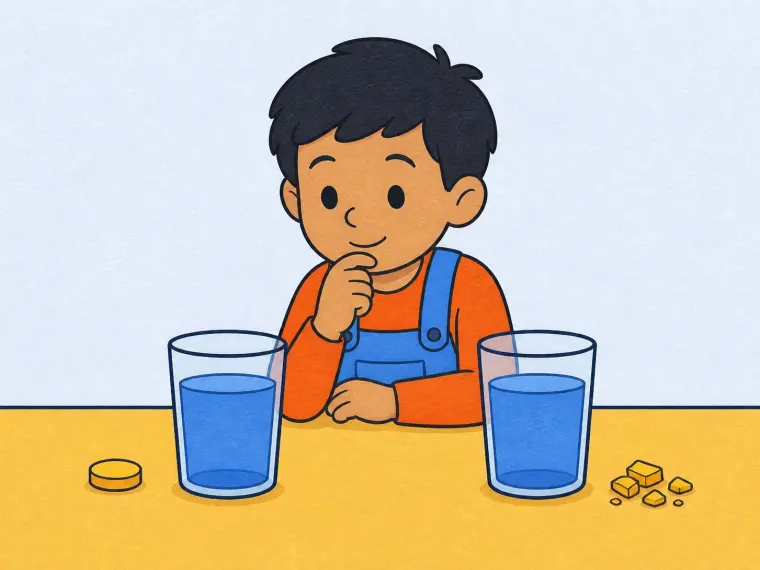
- Predict first: same tablet, two glasses, only the water temperature is different. Which finishes first, and why do you think so?
- Predict first: you crush a tablet to powder before dropping it. What about the tablet has changed that could speed up the fizz?
- Heat and crushing both speed the fizz. What do they have in common — what single thing are both of them increasing?
Where it shows up in real life
- An antacid tablet racing to dissolve in a warm glass of water versus a cold one
- An effervescent vitamin-C tablet erupting faster when you snap it in half first
- Cold soda holding its fizz longer than warm soda once the bottle is open
Free · no login · no student accounts